Categories
News Publications and reports

Lessons to share about planning, implementing and evaluating Community Based Worker Programs

A series of seven Lessons learned resource sheets on planning, implementing and evaluating Community Based Worker programs has been published on the Australian Indigenous Health InfoNet website by the Fred Hollows Foundation.

This series of Lessons learned sheets provide key findings from a review of Community Based Workers (CBWs) employed in the Northern Territory (NT) as part of the Trachoma elimination program, conducted by the Fred Hollows Foundation. The information sheets outline practices that work (practice based evidence) for successfully employing CBWs in programs and projects that require a strong link between the community and the program to ensure program effectiveness.

The Foundation commissioned Pandanus Evaluation & Planning Services to undertake a review of the CBW component to inform program improvement. The literature on CBWs was assessed and an audit of current practices and experiences of programs employing CBWs in remote communities, primarily in the NT, was also commissioned. The information sheets are a key result of the review, and are based on the key findings from the review of the international literature and the results of the audit.


To view all of the  Lesson Learned resource sheets click on the link or go to:

http://www.healthinfonet.ecu.edu.au/key-resources/promotion-resources/?lid=30884


Categories
News

Pacific Women Shaping Pacific Development Program

For the latest news about the Pacific Women Shaping Pacific Development Program visit the website at

http://www.pacificwomen.org

Categories
News

pngaope | Papua New Guinea Association of Professional Evaluators website

pngaope | Papua New Guinea Association of Professional Evaluators website.


Categories
News

Invitation to the Lowitja Congress

Invitation to the Lowitja Congress

Categories
News

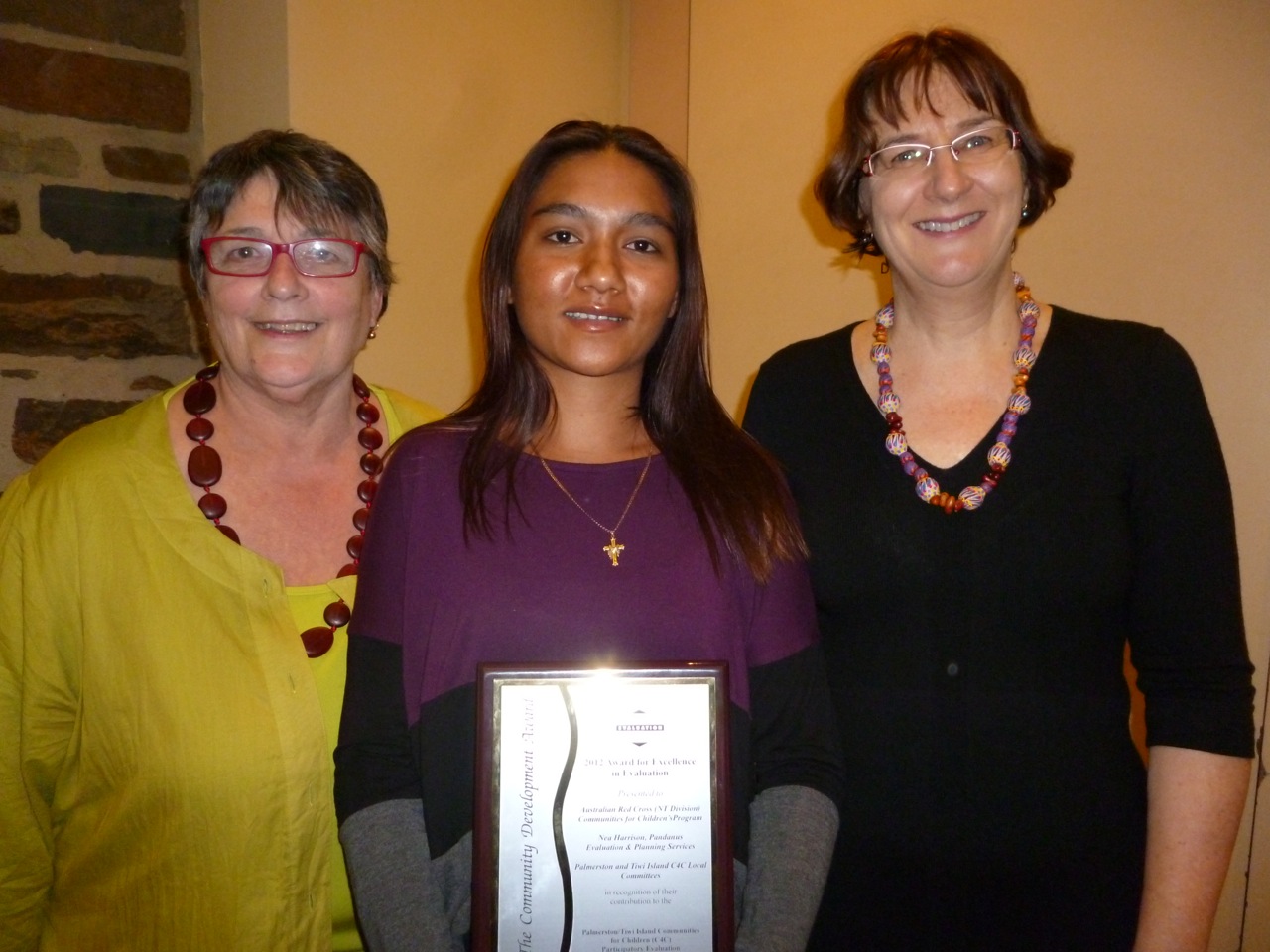
NT Evaluators receive the 2012 Award for Excellence in Evaluation – Community Development Award

The Australian Red Cross (NT) Communities for Children Program, Nea Harrison, Panduanus Evaluation & Planning Services and the Palmerston and Tiwi Islands Communities for Children Local Committees were awarded the 2012 Australasian Evaluation Society (AES) Community Development Evaluation Award for Excellence last Thursday in Adelaide.

The Award was given for the participatory evaluation of the Palmerston and Tiwi Islands Communities for Children’s Activities.

The AES Awards for Excellence in Evaluation recognise exemplary evaluation practice, evaluation systems or evaluation capacity building in Australasia (Australia, New Zealand, Papua New Guinea and Pacifica).

The Awards Committee stated that “the evaluation was well-thought through extremely thorough and comprehensive. The evaluation indicated an understanding both of how an evaluation design contributes to community development goals, and how the use of community development processes enables the accomplishment of the evaluation. The details of the methods and techniques utilised (logic framework, quality rubrics, the Tiwi community report) display mastery.

The areas that stand out as exemplary and examples of good evaluative practice in similar evaluations include:

  • Culturally appropriate evaluation design and methodology
  • strong community engagement and input at all stages of the evaluation from inception to conclusion
  • A developmental approach that was sensitive and worked in sympathy with the local community to enable outcomes that enabled an evaluation that was appropriate and integrated with community culture and values
  • Closure and reporting back to the community
  • Outcomes that resulted in sustainable benefits for local participants (e.g. leadership and skills development and capacity building)
  • The use of advanced techniques – logic framework, quality rubrics, the Tiwi community report.

From inception to conclusion the evaluation was characterised by transparent practices, community involvement, good evaluative practice with the application of advanced techniques to elevate this evaluation to one of excellence and worthy of the AES Award for Excellence in Community Development.”